Bifold vs Sliding Doors: Views, Opening, Thresholds and Cost
Updated: 10 hours ago

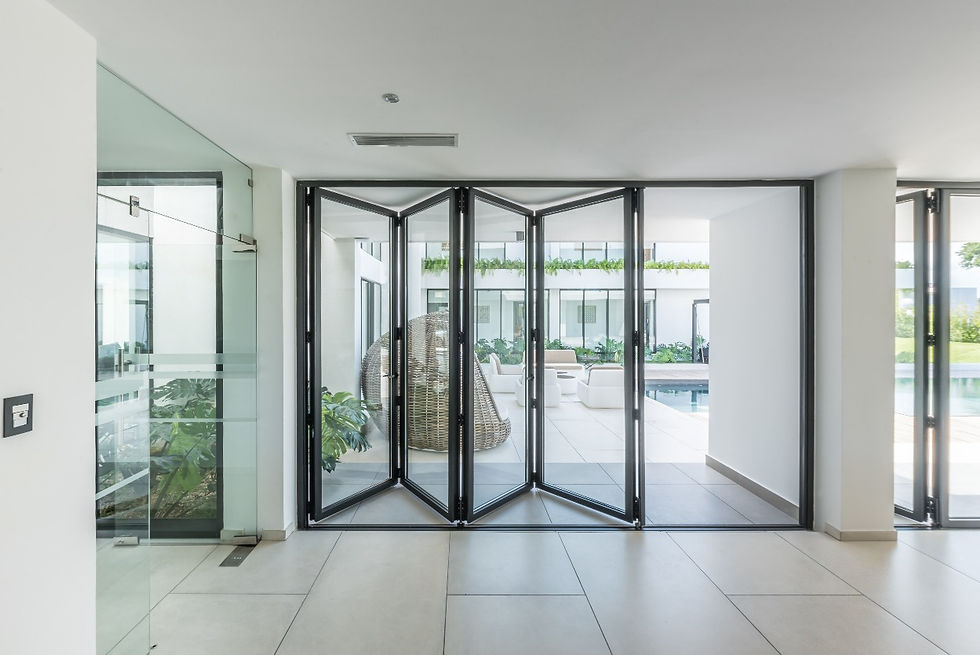
Bifold doors and sliding doors solve the same problem in opposite ways. A bifold folds every pane to one side so the whole opening is clear; a sliding door keeps its panes large and fixed in line, and opens a portion of the width by gliding one behind another. Choose bifolds if a fully open wall on summer days is the point. Choose sliding doors if the view through the glass for the other eleven months matters more.
At a glance:
View when closed: sliding doors, with one or two frames across a four-metre opening against five or six on a bifold.
Opening: bifolds clear almost the whole width; a slider opens half to two thirds unless it is a pocket door.
Everyday use: sliding doors, unless the bifold has a traffic door.
Thresholds: both can be flush.
Security: both are secure when specified to PAS 24; a slider has fewer meeting points.
Cost: set by width, glazing and finish more than by type.
Which gives the better view when closed?
Sliding doors. A sliding set across a four-metre opening might be two or three panes, so there are one or two vertical frames in the view. A bifold across the same width needs five or six panes, each with its own frame, so the view is divided into more, narrower strips. Slim aluminium keeps those frames narrow on both types, but a bifold always has more of them.

Ultra-slim sliding systems take this further. Our ultra-slim frame sliding doors bond the glass to the aluminium so the visible frame almost disappears, with panels up to 15 square metres and motors on the largest so they still glide at a fingertip. When the brief is "the garden, framed by almost nothing", that is the system, and no bifold gets close to it.
Which opens the wider?
Bifolds. A bifold clears the whole opening apart from the stacked panes at one end, so a five-metre wall becomes a five-metre gap. A sliding door can only ever open by the width of its moving panes, which on a two-pane set is half the opening and on a three-pane set with two sliders is two thirds. Pocket sliders, where the panes disappear into the wall, can open fully but need a cavity built for them.

For a kitchen that spills onto a terrace for parties, or a room where you want to bring furniture and the garden into one space, the bifold's full opening is the reason to choose it. For a room where the doors are opened for air and access rather than to erase the wall, a slider's partial opening is rarely a limitation.
How does everyday use differ?
A bifold with a traffic door, a single leaf that swings on its own, is as easy to use daily as an ordinary door. Without one, stepping outside means folding at least two panes, which people do less than they expect. A sliding door is easy every time: one pane moves, in one motion, with one hand. Ask which door you will use on a wet Tuesday in November, not which one you will show visitors in June. Dressing them differs too: a slider takes an ordinary blind, while the options for blinds for bifold doors have to fold with the panes.
What about thresholds and weather?
Both types can be installed with a flush threshold, with the track recessed and a drainage channel outside, so inside and outside floors run level. Sliding doors carry their weight on rollers in the sill and tolerate a flush detail very well. Bifolds can be top-hung, which lifts the running gear away from the wet, and that is our preference where the elevation is exposed. On a sheltered elevation there is little between them.
Which is more secure?
Both are secure when specified properly, with multi-point locking on the meeting stile, shoot bolts on intermediate panes, anti-lift running gear and internal glazing beads. A sliding door has fewer meeting points, so there are fewer places to secure, and the largest panes are far too heavy to force from the track. A bifold has more panes and more hinges, and its security depends on each intermediate pane being bolted to the frame, which a good system does automatically as the set closes. Look for multi-point locking on bifolding and sliding doors, and either type should be specified to PAS 24. For an existing door, our guide on how to secure sliding doors covers the add-ons that help.
Which suits which room?
Kitchen-diners onto a terrace: bifolds with a traffic door, so the whole space becomes one on warm days.
Living rooms and snugs, where the garden is a view rather than a destination: sliding doors, for the uninterrupted glass.
Bedrooms and studies: sliding, because they are opened for air rather than access.
Openings under about 2.4 metres: usually sliding, though a two-pane bifold still suits a side return or a small garden room.
Openings over six metres: either, and this is where the ultra-slim slider with motorised panels earns its place.
What do they cost compared with each other?
Frame for frame the two are priced in the same territory. Sliding doors climb as the panels grow and ultra-slim bonded systems sit at the top; bifolds climb with the number of panes and extras such as a traffic door. The fair comparison is two quotes for the same width and specification. Our guides to bifold doors cost and patio doors cost explain what drives the price, and our guide to aluminium bifold doors covers the specification.
Can you have both?
Yes, and on larger houses this is often the right answer: sliding doors on the elevation with the best view, bifolds on the one that opens onto the terrace. What matters is that both are in the same aluminium system and finish, and match the windows, so the glazing reads as one design across the home rather than as two purchases.
Bifold vs sliding door questions, answered
Which is more energy efficient, bifold or sliding?
With the same thermally broken aluminium frames and the same glazing, the sliding door has a small advantage because there are fewer frames and fewer seals for the same opening. In practice the glazing specification makes far more difference than the door type.
Do bifold doors let in more light?
Not when closed. Sliding doors have more glass and fewer frames for the same opening, so they admit slightly more light. Bifolds admit more air and access when folded open.
Which is easier to maintain?
Sliding doors have fewer moving parts. Both need the track kept clear of grit and the seals wiped occasionally. Neither needs painting, because the aluminium is powder coated.
Can I replace bifold doors with sliding doors later?
Usually yes, because both sit in the same structural opening, though the threshold and drainage may need adjusting.
Talk to our design team
If you are weighing the two for a specific room, the quickest way to settle it is to talk to us about your project with a photograph of the elevation and a rough width, and we will tell you which we would put there and why.