How to Secure Sliding Doors, and What a Well-Made Door Does Differently
Updated: 9 hours ago

To secure sliding doors, start with the four weak points a burglar looks for: a single-point latch that can be forced, a pane that can be lifted off its track, a gap along the bottom rail that a lever fits into, and glass that breaks quietly. Fix those with a proper lock, an anti-lift device, a security bar or bolt, and laminated glass, and an ordinary sliding door becomes a difficult one. A door made to current standards does all of this by design.
7 quick ways to secure a sliding door tonight
Lay a track bar, or a length of dowel cut to fit, in the bottom track behind the closed pane, so it cannot slide even if the lock fails.
Fit anti-lift screws or blocks in the head track above the moving pane, so it cannot be lifted out of the frame.
Add a keyed auxiliary patio door lock at the top and bottom of the moving pane, or a lock that fits over the internal handles.
Fit a hinged security bar across the door at handle height for nights and holidays.
Upgrade the glass: laminated glass when the units are next replaced, or security film as a cheaper interim step.
Add a door contact or glass-break sensor to your alarm, and a light on a sensor over the door.
Check the existing lock actually engages: close the door, lock it, and make sure every hook and bolt throws into its keep.
Do those seven things and the door is no longer the easy way in. Each step is explained below.
What is the weakest point on a sliding glass door?
The lock, almost always. A standard sliding patio door closes on a single hook latch operated by a thumb turn. It holds the door shut against wind; it is not designed to resist a person. A screwdriver in the gap between the meeting stiles, or a firm shoulder, is often enough. If your door has one small latch and nothing else, that is where to begin.
The second weakness is the track. On older doors the sliding pane sits on rollers in a shallow channel, and if the pane can be lifted a centimetre it can be tipped inwards and taken out of the frame from outside. Try it from inside: lift the moving pane firmly upwards. If it rises and rocks, it can be lifted from the garden.
How do you stop a sliding door being lifted off the track?
Fit anti-lift blocks or screws. The simplest version is a pair of screws driven part way into the top channel above the sliding pane, heads left proud so the pane cannot rise far enough to clear the bottom track. Purpose-made blocks do the same more tidily. After fitting, the pane should slide freely but not lift more than a few millimetres.

What locks can you add to an existing sliding door?
A surface-mounted patio door lock, a small keyed bolt fixed to the inside of the moving pane, is the single most effective addition. Fit one at the bottom rail and one at the top so the pane is pinned at both ends, and use a keyed model so the bolts cannot be knocked open through a broken pane.
If the existing latch is worn, replace it with a two-point or hook-and-bolt version made for the same profile. On some doors the whole lock body can be swapped for a multi-point version; a locksmith can confirm whether the profile allows it.
Does a security bar work on sliding doors?
Yes, and it is the cheapest measure of all. A length of timber or an adjustable steel rod laid in the bottom track behind the closed pane stops it sliding open even if the lock fails. It does nothing about lifting, so it belongs with anti-lift screws rather than instead of them.
Should you upgrade the glass?
If the frames are sound, laminated glass is the upgrade that changes the door most. It has a clear interlayer bonded between two panes, so when struck it cracks but stays in one piece. Toughened glass, which most patio doors have, breaks into granules all at once: safe for people, convenient for intruders. A laminated inner pane in a new sealed unit adds security and cuts noise, and a glazier can fit it to the existing frames.
Also check the glazing beads, the strips that hold the glass in the frame. If they are on the outside and can be prised out, the glass can be removed without breaking it. Internally beaded doors, or external beads with security tape and clips, close that route.
Do sensors and lighting help?
They help the door you cannot otherwise improve. A contact sensor on the moving pane linked to an alarm, a glass-break sensor, and a light on a sensor over the door all raise the cost of trying. None of them stops a door being opened; they make it a noisy, visible thing to do.
When is it better to replace the door?
When the frame flexes, the rollers are worn so the pane sits crooked, the lock cannot be upgraded because the profile is obsolete, or the glass is single glazed. At that point every add-on is working around a weak structure. A new aluminium sliding door is a different object: the security is designed into the frame, the lock and the glass together rather than bolted on afterwards.
What does a well-specified new sliding door do differently?
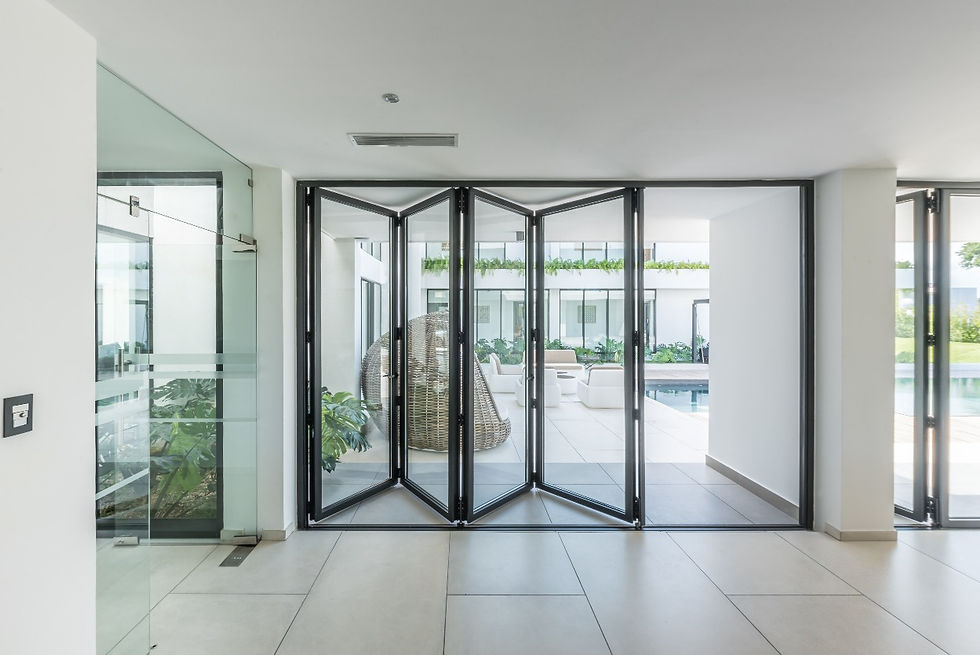
Our bifolding and sliding doors have multi-point locking as standard: hooks and bolts engage along the meeting stile, shoot bolts throw into the head and sill, the pane cannot be lifted from outside, and the glass is internally beaded. Cylinders are rated against snapping, drilling and bumping. On our ultra-slim frame sliding doors hidden locks engage claws and shoot bolts, and motorised panels can lock automatically when they close.

Ask for PAS 24, the UK test in which the complete door, glass and lock are subjected to forced-entry tests. Secured by Design, the police-backed scheme, builds on it, and some insurers ask what standard your external doors meet, so keep the paperwork. Our comparison of bifold vs sliding doors covers how their security differs.
Sliding door security questions, answered
Can you put a lock on a sliding glass door?
Yes. Surface-mounted keyed patio bolts fit almost any sliding door and pin the pane to the frame at the top and bottom. On many profiles the latch itself can be replaced with a hook-and-bolt or multi-point lock.
Are sliding doors less secure than bifold doors?
No. A sliding door has fewer meeting points to secure and its largest panes are far too heavy to force off a track. Both are secure when made to PAS 24 with multi-point locking, shoot bolts, anti-lift running gear and laminated glass.
What is PAS 24?
A British forced-entry test for doors and windows, applied to the complete doorset including glass and locks. Any new external door should meet it.
Talk to our design team
If your doors have reached the point where adding to them no longer feels like enough, talk to us about your project and we will look at the opening with you and specify a door where the security is built in.