Aluminium Bifold Doors: What to Specify and Why
Updated: 10 hours ago

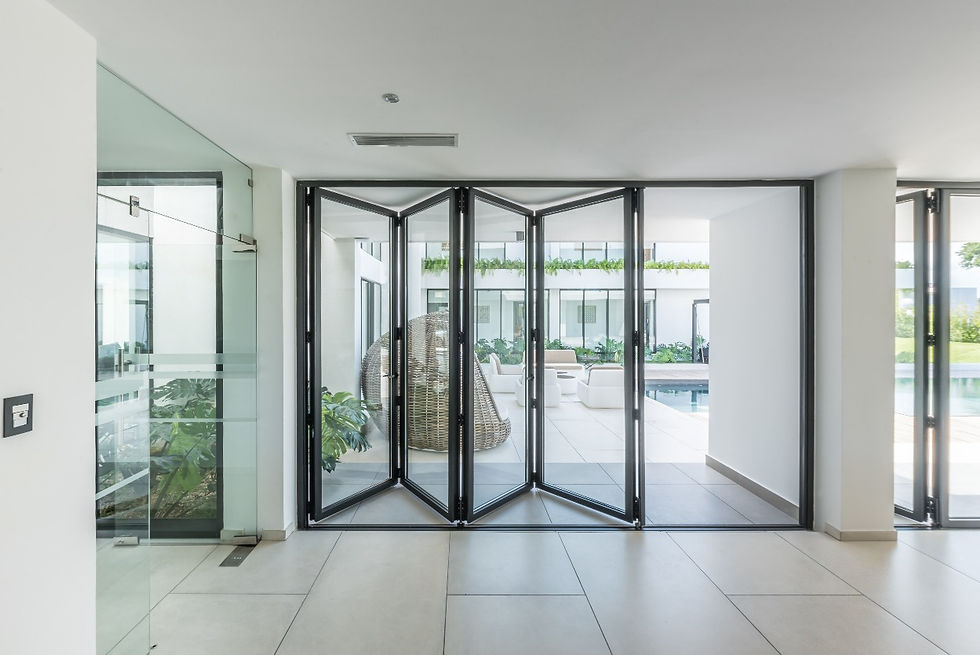
Aluminium bifold doors are external folding doors made from thermally broken aluminium, with each glazed pane hinged to the next so the whole wall folds to one side and stacks neatly against the reveal. They are chosen over other frame materials for one reason above all: aluminium is strong enough to hold large panes of glass in a frame that stays slim, so you see more garden and less door.
What makes aluminium the right frame for bifold doors?
A bifold door lives a harder life than a window. Every pane is hinged, rolled along a track, and pushed and pulled several times a day for years. Softer materials flex, swell and drop over that time, and a door that drops stops meeting its locks. Aluminium does not swell with moisture and holds its shape, so a well-made set closes as cleanly in its tenth year as it did in its first.
The other advantage is proportion. Because the alloy carries more load than timber or standard frame systems of the same section, the frame around each pane can be narrower. On a typical five-pane set that difference adds up to a noticeably larger area of glass and a cleaner line across the opening.
Modern aluminium frames are thermally broken: a continuous polyamide strip separates the outer and inner aluminium so cold cannot travel straight through the metal. In England a replacement external door needs a U-value of 1.4 W/m²K or better under Part L, which a thermally broken set with modern double glazing is designed to meet.
How many panes should an aluminium bifold door have?
Between three and seven panes covers most openings. Each pane is typically between 700mm and 1,200mm wide, so as a rough guide:

Up to about 2.4m: two or three panes.
About 2.4m to 3.6m: three or four panes.
About 3.6m to 4.8m: four or five panes.
About 4.8m to 6m: five or six panes.
Over 6m: six or seven panes, or a split stack.
Wider panes mean fewer frames and a cleaner view, but each is heavier, so there is a practical ceiling.
The number of panes also decides how the set opens. An odd number lets you have a traffic door, a single leaf at one end that swings open on its own like a normal door, so you can step outside without folding the whole wall back. An even number folds cleanly in two halves, one stacking to each side, which suits very wide openings where you want the stack split.
For a kitchen or living room that opens onto the garden, we usually recommend a traffic door. It is the leaf you use every day, and it means the folding action is saved for the days you want the whole wall open.
What are external bifold doors made of, beyond the frame?
Four parts do the work: the frame; the sealed, toughened glazed units; the running gear, stainless steel rollers on a track in the head or sill, whose quality decides whether the door glides; and the seals that stop rain and draughts. Our bifolding and sliding doors are made to measure, with the same finish available on matching aluminium windows and doors so the glazing reads as one design.
Which threshold should you choose?
The threshold is where the door meets the floor, and there are three common options. A standard rebated threshold sits proud of the floor and gives the best weather performance, which suits exposed elevations. A low threshold reduces the upstand to a small lip that most people step over without noticing. A flush threshold sets the track into the floor so inside and outside run level, which is the look most clients want and the one that needs the most careful drainage.
A flush threshold is achievable on almost any project provided the external paving is set below the internal floor and a drainage channel runs along the outside of the track. Where that cannot be done, a low threshold gives most of the effect with none of the risk.
What glazing goes into aluminium bifold doors?
Double glazing with a low-emissivity coating and an argon-filled cavity is the sensible baseline. Triple glazing improves both insulation and sound reduction, at the cost of heavier panes, which may reduce the maximum width of each leaf. On a south or west facing elevation, solar control glass keeps the room from overheating in summer without tinting the view.
All glass in a bifold is toughened, so it breaks into small granules rather than shards if it ever fails. Laminated glass, which holds together on a clear bonded interlayer even when cracked, adds security and further sound reduction and is worth specifying on ground-floor doors that face a quiet road or a shared boundary. Integral blinds can also be sealed inside the units at this stage, one of the options in our guide to blinds for bifold doors.
What colours and finishes are available?
The powder coat is baked on, in any RAL colour, and dual colour is standard: one colour outside to suit the brick, another inside. Anthracite grey and black are the most requested; off-whites, bronzes and soft greens suit older brick. A wash twice a year is all the frames need.

How secure are aluminium bifold doors?
Very, when they are specified properly. The locking on a good set is multi-point, so turning the key throws hooks or bolts at several heights along the meeting stile. Shoot bolts at the top and bottom of each intermediate pane lock the folding leaves to the frame, and the running gear is designed so panes cannot be lifted off the track from outside. Internal glazing beads mean the glass cannot be removed from outside either. For a new set we would expect it to meet PAS 24, the UK standard for enhanced security doors, and to use a cylinder rated against snapping and bumping. Much of the same thinking applies to sliders, as our guide on how to secure sliding doors explains.
How do bifold doors compare with sliding doors?
A bifold opens the whole width; a slider opens a portion but has fewer frames in the view when closed, which is most of the year. Our guide to bifold vs sliding doors compares them in detail.
What do aluminium bifold doors cost?
The cost is driven by width, the number of panes, the glazing specification, the threshold and the finish, in roughly that order. A three-pane set in a standard colour with double glazing sits at the entry point; a seven-pane set with triple glazing, dual colour and a flush threshold is a different order of investment. We explain what drives the price in our guide to bifold door costs, including what installation and building work add.
Aluminium bifold door questions, answered
Do aluminium bifold doors get cold or suffer condensation?
Not when the frames are thermally broken and the glazing is a modern sealed unit with a low-emissivity coating. Older aluminium doors without a thermal break did get cold, which is where the reputation came from. Current systems perform as well as any frame material.
How long do aluminium bifold doors last?
Commonly 30 years or more for the frames. The parts that wear, the rollers and seals, are replaceable, and keeping the track clear of grit is the best thing an owner can do.
Do I need planning permission for bifold doors?
In England, replacing doors in an existing opening on a house does not normally need planning permission unless an Article 4 direction applies; listed buildings need listed building consent, and flats may need permission. Building regulations still apply, certified by a FENSA or CERTASS-registered installer, and a new or wider opening needs building regulations approval for the lintel.
Talk to our design team
To settle the opening, the pane count and the finish before anything is priced, talk to us about your project.