Roof Lanterns for Flat Roofs: How a Lantern Sits on a Flat Roof and What to Specify
Updated: 9 hours ago

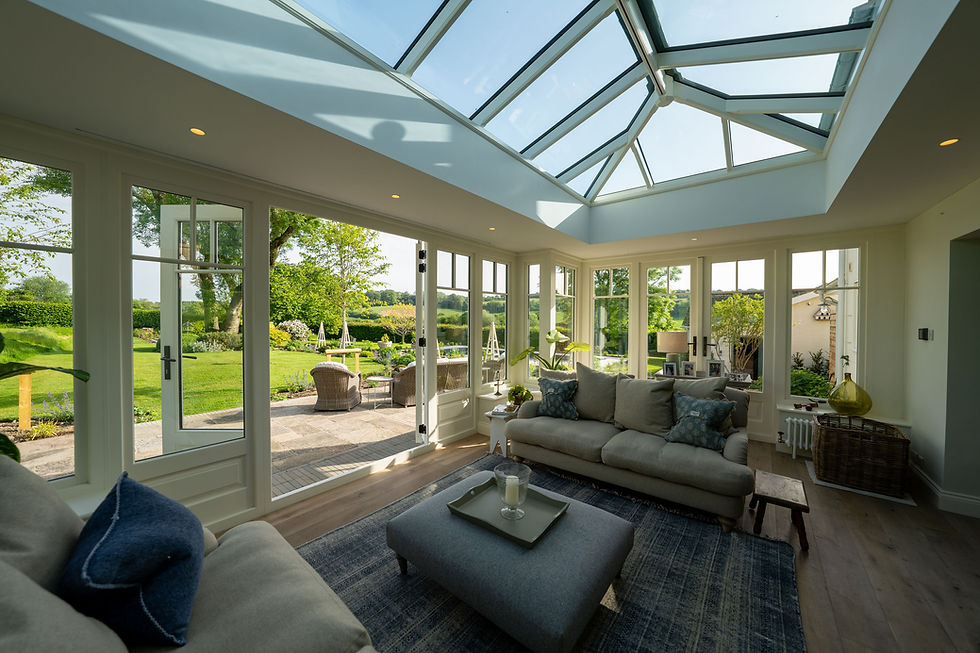
Roof lanterns for flat roofs are glazed structures that sit proud of a flat roof on an insulated upstand, drawing daylight down into the room below from every angle and giving a flat-roofed space the height and focal point it otherwise lacks. Almost every lantern is a flat roof lantern; the pitched roof of the lantern is what makes it work, and the flat roof is what makes it possible.
How does a roof lantern sit on a flat roof?
On an upstand, sometimes called a kerb. The upstand is a timber or insulated frame built up from the flat roof structure, usually 150 millimetres or more above the finished roof surface, with the roof membrane dressed up and over it so the junction is weatherproof. The lantern's base frame is fixed to the top of the upstand, and the glazed pitches rise from it to a ridge. Rain runs down the glass to the base frame and onto the flat roof, and from there to the roof's own drainage.

The upstand does three jobs. It lifts the lantern clear of standing water and snow. It carries the lantern's weight into the roof joists, which must be trimmed around the opening to take it. And it provides the insulated, airtight seal between the warm room and the lantern frame. A poorly built upstand is the cause of most lantern problems, which is why it should be built by the roofer to the lantern manufacturer's drawing rather than improvised.
How big should a flat roof lantern be?
In proportion to the room, not to the roof. A lantern that fills most of the flat roof looks like a greenhouse from outside and floods the room with more heat than light. A lantern that is too small reads as a skylight and does not give the sense of height a lantern is for. As a rule of thumb, a lantern's glazed area is about a quarter to a third of the ceiling it sits in, adjusted for orientation and room use. That lights the room well and still leaves solid ceiling around it for lighting, extraction and the sense of enclosure a kitchen needs.
Shape follows the room. A long room takes a long lantern centred over the island or the table. A square room takes a squarer one. Two lanterns in a run suit a wide, shallow extension where one large lantern would be out of scale. Every lantern we supply is made to measure, single or in a run, so the size follows the room rather than a stock list; our guide to roof lantern cost and sizes explains the common sizes and what drives the cost.
What glazing should a flat roof lantern have?
Thermally broken, slim-frame aluminium with sealed double or triple glazing, and on any south or west-facing roof, solar-control glass. A flat roof lantern faces the sky, so it takes the sun for most of the day; solar-control coatings reflect the infrared energy and keep the room from overheating while letting the daylight through. Self-cleaning glass is worth specifying because nobody is going to climb onto the flat roof to wash it. Triple glazing improves comfort in winter and cuts condensation risk on the inside of the glass. The roof lanterns we install are slim-frame thermally broken aluminium, with solar-control and self-cleaning glass, double or triple glazed, in any RAL colour.
Sightlines matter more on a lantern than anywhere else in the house, because you look up into it. Slim frames and a minimal ridge keep the view mostly glass; heavy frames turn the lantern into a cage.
Lantern or flush rooflight?
A lantern rises from the roof and gives height, a ridge line and a visible feature, which suits an orangery, a period house or a kitchen extension with a plastered ceiling. A flush rooflight lies in the roof with no visible frame from inside, which suits a modern glass box extension where the roof is meant to disappear, and our glass room extension guide covers fully glazed roofs. Our guide to orangery roof lanterns covers the orangery case.
What should you check before ordering a lantern for an existing flat roof?
Four checks, in this order:
The structure. The joists around the opening must be trimmed and, on a wide opening, doubled or replaced with a steel. A lantern is not heavy, but the opening removes the joists that would have carried the roof there, so an engineer should confirm the trimmers.
The roof covering. A lantern on a felt roof near the end of its life is a mistake, because the upstand needs the membrane re-dressed and the roof may need recovering anyway.
The fall. Water must drain away from the upstand rather than towards it.
The ceiling below. A lantern needs a shaft or a splayed reveal through the ceiling void, and the deeper the void, the more the reveal design matters to how the light arrives in the room.
Does a roof lantern on a flat roof need planning permission?
Often, yes. In England a rooflight added to an existing roof is permitted development only if it projects no more than 150 millimetres above the roof plane, as the Planning Portal sets out, and a lantern on an upstand normally exceeds that. Check with the council before ordering; a lawful development certificate gives certainty. Listed buildings need consent. A lantern designed into a new extension is assessed with the extension and counts within its 4 metre height limit. Building regulations apply to the structural opening and the glazing's thermal performance either way.
Roof lanterns for flat roofs questions, answered
Can a lantern go on a warm flat roof?
Yes. The upstand is insulated to match the roof build-up so there is no cold bridge at the junction. The membrane is dressed over the upstand in the same way as on a cold roof.
Will a flat roof lantern leak?
Not if the upstand is built to the drawing and the membrane is properly dressed and terminated. The lantern itself is a sealed frame; the risk sits at the junction, which is why the roofer and the lantern installer need to work to the same detail.
Does a lantern make a flat-roofed room hot?
It can, on a south-facing roof with standard glass. Solar-control glazing removes most of the problem, and blinds handle the rest.
Talk to our design team
If your flat-roofed room is bright but flat, a lantern is the piece that gives it height, and our roof lanterns are sized and specified for the room beneath them; we are happy to look at the roof with you before anything is ordered.