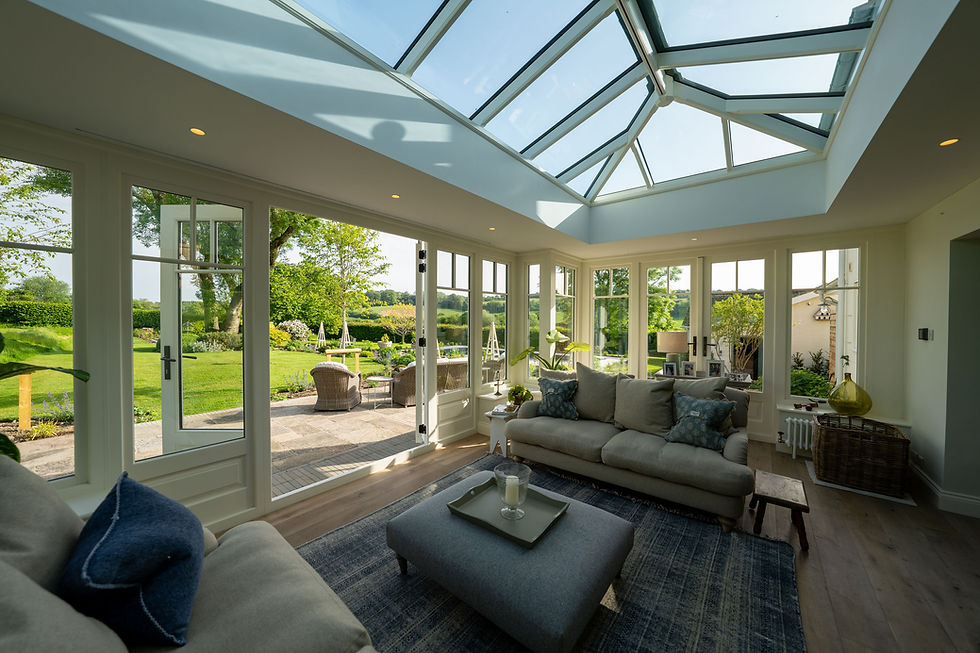
Roof Lantern Blinds: Electric Pleated, Integral Blinds and the Glass Alternative

Roof lantern blinds are shading fitted to the underside of a glass roof lantern, or sealed inside its glazing, to cut glare and heat in summer and soften a dark rectangle of sky at night. A lantern pours daylight into the middle of a room, which is the point of it, but on a south-facing kitchen in July that daylight arrives with heat, and the same glass that lights the room can become the thing you want to cover. The right answer is sometimes a blind and sometimes better glass, and this guide explains which is which.
Why would a roof lantern need blinds?
Three reasons, and they lead to different solutions.

Heat is the first. A lantern over a kitchen island on a south-facing elevation can raise the room temperature noticeably on a summer afternoon. Blinds reduce it, but solar-control glass reduces it more, because it stops the heat before it enters the room rather than after.
Glare is the second. Low sun through a lantern can be uncomfortable at a table beneath it. A blind, even a light one, solves this in a way glass cannot.
The night-time black hole is the third. A lantern with no blind is a dark rectangle in the ceiling after dusk, and in a room with warm lighting some people find it cold. A pleated blind closed at night gives the ceiling back.
Which blinds fit a roof lantern?
Electric pleated blinds are the standard. A pleated fabric runs on tensioned cords or guide wires in a slim frame fixed to the underside of the lantern kerb, one blind per glazed face or one per pitch. A small motor moves each blind, and the set runs from a remote, a wall switch or the same app as the rest of the room. Fabrics range from sheer to blackout, and a reflective backing on the top side bounces heat back out through the glass before it reaches the room.
Integral blinds sit inside the sealed glass unit itself, between the two panes, so there is no fabric, no cords and nothing to clean. They are operated magnetically or by a small motor in the frame. The limitation is that they must be specified when the lantern is made, because they are part of the glazing; they cannot be added later.
Manual pleated blinds exist, but a lantern is out of reach by definition, so a pole or a cord loop is required and the blinds tend not to get used.
Which system suits a given lantern depends on whether the glass has been made yet and how deep the kerb is, so it is worth asking before the lantern is ordered. We supply lantern blinds alongside our other orangery and conservatory accessories.
How are electric roof lantern blinds fitted?
The blind frames fix to the internal face of the lantern kerb or to the underside of the glazing bars, so the fabric runs parallel to the glass on each face. A pitched lantern with four glazed sides needs four blinds, or two on a two-pitch lantern. Power comes from a low-voltage transformer, which means a cable run to the lantern position; on a new build this is planned in, and on an existing lantern it is usually routed through the kerb or the ceiling void. Battery-powered motors are available where a cable is impractical, at the cost of periodic charging.
The best time to fit blinds is when the lantern is installed, because the frame, the power and the control can all be designed together. Retrofitting is possible on most lanterns, but the kerb has to be deep enough to take the blind frame without fouling the glass.
When is solar-control glass the better answer?
When heat is the problem and glare is not. Solar-control glazing has a coating that reflects a large share of the sun's infrared energy while letting visible light through, so the room stays bright and much cooler without anything covering the glass. It costs more than standard glazing, but it is specified once and never needs operating, cleaning or replacing. Self-cleaning coatings can be combined with it, which matters on a lantern nobody can reach. Our roof lanterns are available with solar-control and self-cleaning glass, in double or triple glazing, and on a south-facing room we would specify solar-control glass first and add blinds only if glare or the night view calls for them.
The combination that works best on an exposed lantern is solar-control glass plus a light pleated blind: the glass handles the heat, the blind handles glare and the evening.
What do roof lantern blinds cost?
It depends on the number of glazed faces, the size of each blind, the fabric and whether the motors are wired or battery. Integral blinds add to the price of the glass unit rather than being a separate item. As a rule the blinds are a fraction of the lantern itself, and if you are choosing between blinds and better glass on a tight budget, the glass is the better first purchase. Our guide to roof lantern cost and sizes sets out what the lantern itself costs, and our guide to roof lanterns for flat roofs covers how the lantern sits on the roof.
Roof lantern blinds questions, answered
Can blinds be fitted to an existing roof lantern?
Usually, if the kerb is deep enough to take the blind frame and a power supply can be run to it. Integral blinds cannot be retrofitted because they are inside the glass.
How do you clean blinds you cannot reach?
Pleated fabrics shed dust when operated and rarely need more than an occasional vacuum with an extension. Integral blinds never need cleaning, which is one of their main attractions on a lantern.
Are electric blinds noisy?
The motors are small and quiet. A set of four blinds closing takes a few seconds and is barely audible over a conversation.
Talk to our design team
If your lantern is bright in the right way in April and the wrong way in July, the fix is either glass or a blind, and we are happy to look at the room and advise which before you buy either.