Aluminium Pergola: Why Metal Beats Timber
Updated: 10 hours ago

An aluminium pergola is a garden or patio structure with a powder-coated aluminium frame, most often carrying a louvred roof that opens and closes, and it is the material we build every pergola in. Aluminium does what a pergola needs: it spans wide openings on slim posts, it carries the weight of a motorised roof and glass sides, it never rots, warps or needs repainting, and it can be finished in any RAL colour to match the doors and windows beside it. A metal pergola with a roof is, in practice, an aluminium pergola with a roof; steel is heavier, rusts unless galvanised and is rarely used for domestic patio structures.
Why choose an aluminium pergola over timber?
Timber pergolas are beautiful when they are open to the sky. The trouble starts when you put a roof on: the added weight, wind load and drainage make timber posts and beams grow heavy, and timber moves with moisture, which is a problem for any roof that has to seal. Aluminium carries the same loads on slimmer sections, does not move, and accepts motors, sensors, lighting and glass sides as designed components. On our pergola glass rooms every element is powder-coated aluminium, including the concealed gutters that carry rain down through the posts.
Life: aluminium does not rot or warp; timber lasts well only with regular treatment.
Maintenance: aluminium needs a wash; timber needs staining or painting every few years.
Span: aluminium spans wider openings on slimmer posts.
Roof options: aluminium takes a louvred, glass or retractable roof; timber is usually left open or given a simple cover.
What roof does a metal pergola have?
Usually a louvred one. Aluminium blades rotate up to 140 degrees, so the roof can be fully open for sun, angled for shade and airflow, or closed flat into a rain-tight surface. On the systems we install the blades can also slide fully open. Motorised controls and weather sensors adjust the louvres for you, closing the roof at the first sign of rain and against wind above a set speed. The Weinor pergolas we fit as the Artares system house a drive inside each louvre, so the movement is quiet and the mechanism is protected from the weather.
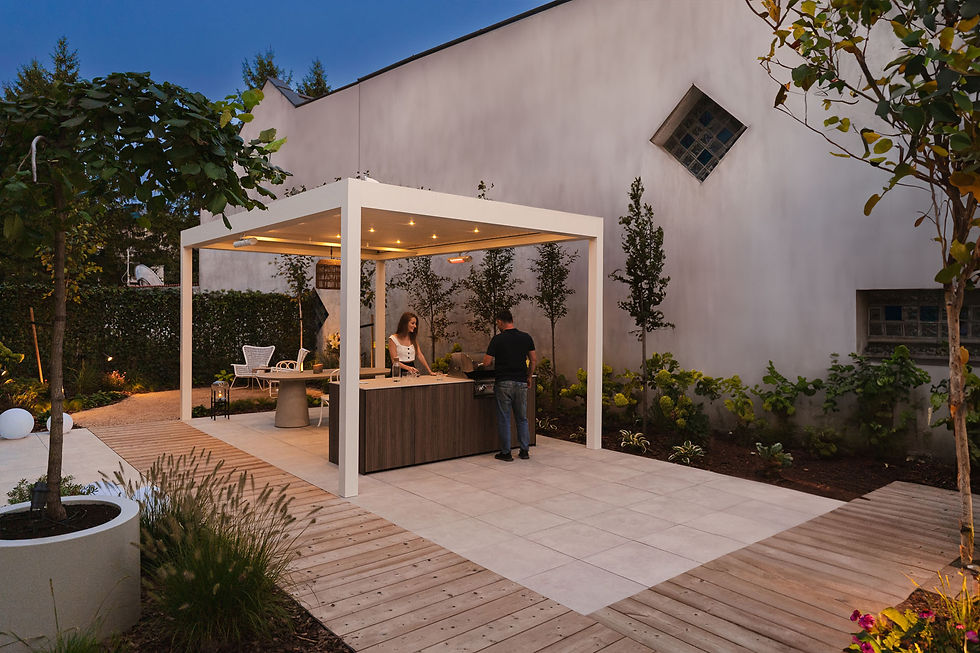
A fixed glass roof is the other option on an aluminium frame, and at that point the structure is a veranda rather than a pergola. A fabric retractable roof is possible but it gives up the year-round shelter that makes a metal pergola worth building. Our guide to a pergola with a retractable roof compares the two properly.
How big can an aluminium pergola be?
Wider than timber for the same post size. The Artares modules we install are made to measure up to 7 metres wide, with head clearance up to 3 metres, and they can be coupled into runs spanning up to 24 metres for a long terrace or a commercial patio. Depth from the house wall is normally 3 to 4 metres for a dining space, which keeps the table under the roof rather than at its edge. As a rough guide, a table for four fits under about 3m x 3m, six under about 4m x 3m, and eight with a lounge corner needs something nearer 6m x 4m.
The practical limit is usually the house, not the pergola. A wall-mounted structure has to clear the doors and sit below first-floor windows, so on a low elevation the shallow profile of a louvred roof is an advantage.
Freestanding or wall-mounted?
Wall-mounted aluminium pergolas sit outside the doors and extend the kitchen or living room into the garden; that is how most are used. Freestanding pergolas stand on four or more posts wherever the garden offers the best light or the best view, and they give a large garden a destination. A corner pergola, fixed into the angle of two walls, sits between the two. Both are built from the same system, and both drain through the posts, so there is no visible guttering either way. If the structure will lean against the house, our guide to the lean to pergola covers the fixing and drainage detail.
Which finish and colour?
Powder coating in a bespoke RAL colour. Anthracite grey and black are the most requested because they disappear against modern glazing and let the roof read as a shadow line. White or a pale grey suits a rendered house. Matching the pergola to the door and window frames is the single choice that makes the structure look designed rather than bought, so take the RAL reference from the joinery you already have.

What can an aluminium pergola carry later?
Frameless sliding glass sides, fabric screens, shutters, LED lighting and infrared heating can all be added when you are ready, because the frame is engineered for those loads, turning it into a pergola with roof and sides. The one thing to do now is say what the pergola might one day become, so posts, wiring and tracks are specified for it.
What does an aluminium pergola cost?
More than a timber frame and less than a glass extension. The main variables are:
Size: width, depth and whether more than one module is coupled together.
Roof: a motorised louvred roof costs more than a fixed or fabric one.
Sides: frameless glass, screens or shutters on one or more sides.
Extras: lighting, heating, sensors and app control.
Ground and fixing: foundations for the posts and the condition of the house wall.
We explain what drives the price in our guide to pergola cost. The long-term arithmetic favours aluminium: no repainting, no replacement fabric, no rot.
Aluminium pergola questions, answered
Does an aluminium pergola get hot in the sun?
The frame warms in direct sun like any metal, but the louvres are what you sit under, and angled or closed they shade the space. Powder-coated aluminium does not transmit heat into the room the way a glass roof can.
Will it rust?
No. Aluminium does not rust, and the powder coating protects the surface from weathering and UV. Near the coast, ask for a coastal-grade pre-treatment under the powder coat. A wash once or twice a year keeps the finish as it was.
Is a metal pergola noisy in rain?
Rain on closed aluminium louvres is audible but soft, closer to rain on a car roof than on a tin shed, and the concealed gutters take the water away quietly.
Can an aluminium pergola be fixed on decking?
The posts need a solid bearing. On a paved patio they sit on pads or a suitable slab; on decking the loads are taken through to foundations beneath it rather than onto the boards.
Does an aluminium pergola need planning permission?
Often not in England, if it stays within permitted development limits for height and position, but a roofed structure attached to the house is judged differently from a freestanding one. Our guide to pergola planning permission sets out the limits.
Talk to our design team
If you want a pergola that will still be straight, sealed and the same colour in twenty years, our pergola glass rooms are built in aluminium for exactly that reason, and we are happy to talk through your patio before anything is specified.