Pergola With a Retractable Roof: Louvred or Fabric, and What to Choose
Updated: 12 hours ago

A pergola with a retractable roof is a patio structure whose roof opens and closes, so you get sunshine when you want it, shade when it is too bright and a rain-tight cover when the weather turns. There are two ways to build one. A louvred roof uses aluminium blades that rotate up to 140 degrees and, on some systems, slide fully open. A fabric roof uses a tensioned textile that retracts along tracks into a cassette. Both count as retractable; they behave very differently.
This guide explains how each type works, where each one suits, and the extras that turn a retractable-roof pergola from a shade structure into an outdoor room.
How does a louvred retractable roof work?
The roof is made of horizontal aluminium louvres set into a frame. A motor rotates them: fully open for direct sun and airflow, angled to cut glare while keeping the breeze, or closed flat so the blades overlap into a rain-tight surface. Rainwater then runs off the closed roof into concealed gutters and down through the posts, so there are no downpipes hanging off the structure. On the systems we install, the blades can also slide fully open, leaving the frame and nothing above you.

A fixed glass roof is always closed and an awning is either out or in; louvres give every setting in between, and with sensors the roof closes at the first sign of rain whether you are there or not. Our pergola glass rooms are built on this principle.
How does a fabric retractable roof work?
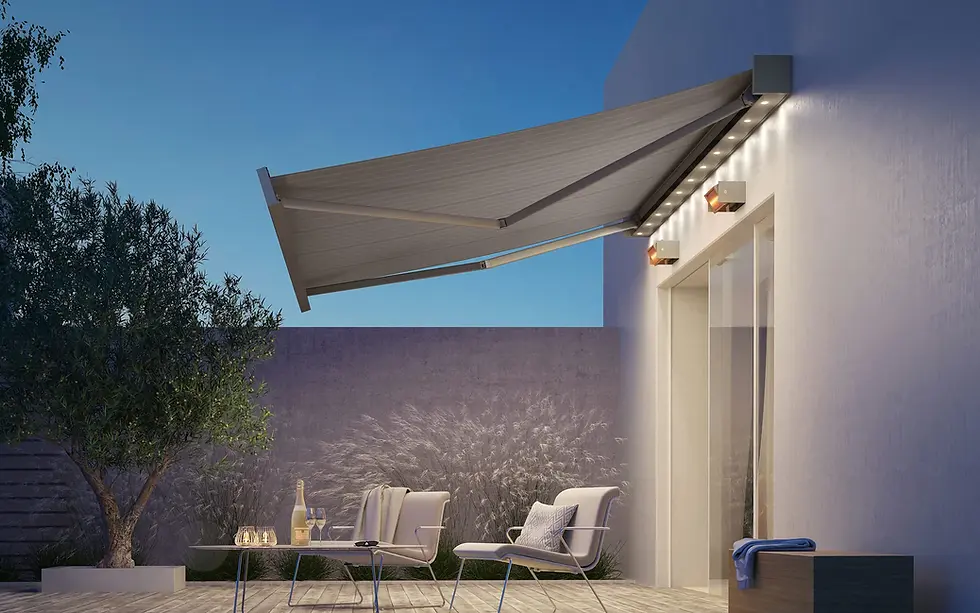
A fabric roof is a large textile panel that runs on tracks along the pergola beams and gathers into a cassette at one end when retracted. Extended, it shades the whole area and sheds light rain; retracted, it leaves the frame fully open. It is lighter and simpler than a louvred roof and it suits a purely shade-led brief. The systems we fit are made by Weinor.

Its limits are the ones you would expect from fabric. It cannot be angled, so it is either shading or not. Heavy rain, snow load and strong wind are managed by retracting the roof rather than by the roof holding firm, so on an exposed site it will spend a lot of the year closed away. And fabric has a working life measured in years rather than decades, whereas powder-coated aluminium louvres do not.
Which retractable roof suits which patio?
Choose louvres if you want to use the patio in more of the year, if the site catches wind, or if you think you might one day close in the sides with glass. Choose fabric if the brief is summer shade over a sheltered patio and you want the lightest possible structure.
Orientation matters too. A south or west-facing patio that bakes from midday onwards benefits most from louvres, because you can angle them to take the edge off the sun while keeping the light. A north-facing patio that is already cool and shaded gets more from a fixed glass roof than from either retractable option, since there the problem is rain, not sun.
Freestanding or fixed to the house?
Both work. A wall-mounted retractable-roof pergola sits directly outside the doors and becomes a covered extension of the kitchen or living room, which is how most people use one. A freestanding pergola can go anywhere the garden has the best light or the best view, and it gives the garden a destination. The louvred systems we fit are available in both forms, and larger patios can be covered by coupling modules into longer runs. The Weinor pergolas we install as the Artares system are made to measure up to 7 metres wide per module, with head clearance up to 3 metres, and can be coupled into runs of up to 24 metres.
What can you add to a retractable-roof pergola?
The roof is the beginning. The additions are what make the space usable on a cool evening or a windy afternoon.
Sliding glass sides: frameless panels that close the open sides into a glass room and slide away in seconds when the sun comes out.
Vertical screens: taut fabric screens that drop from the frame for glare, privacy and wind, then vanish when not needed.
Sliding shutters: aluminium blades along the sides for adjustable shading and privacy.
LED lighting: strips in the louvres, the fascia or the posts, warm white or coloured.
Infrared heating: wall or frame-mounted heaters that warm people rather than air, which is what you want in an open structure.
Weather sensors and app control: rain, wind and sun sensors that manage the roof for you, with everything on one climate control app.
Specify these at the design stage even if you add them later. The posts, the wiring runs and the frame sections all depend on what the structure will eventually carry.
Does a pergola with a retractable roof need planning permission?
At the rear of a house in England, usually not. The retractable roof does not change the planning position: height, depth and distance to the boundary do, and listed buildings, conservation areas and flats are the main exceptions. Our guide to pergola planning permission sets out the limits.
What does a retractable-roof pergola cost?
Louvred roofs cost more than fabric roofs, and the sides, heating and lighting add more again. We set out what drives the cost in our guide to pergola cost. If the budget pushes you towards a plain frame, our guide to the aluminium pergola covers what you get from the structure alone.
Retractable roof pergola questions, answered
Is a louvred roof fully waterproof?
When the louvres are closed they overlap into a sealed surface and rainwater is channelled into hidden gutters and away through the posts. In practice a closed louvred roof keeps the patio dry in heavy rain.
Can the roof be left open in wind?
Louvres are aluminium and are not damaged by wind in the way fabric is, but with a wind sensor fitted the system will close them automatically above a set speed for comfort and safety.
How noisy are the motors?
The systems we install use low-noise drives housed inside the louvres or the frame. The movement is quiet enough not to interrupt a conversation underneath.
Talk to our design team
If you want a roof that changes its mind with the weather, our pergola glass rooms are designed and installed around your patio, and we will talk you through the options before anything is drawn.