How Much Does a Pergola Cost?
Updated: 8 hours ago
A pergola typically costs £900 to £3,000 in timber, £3,500 to £6,000 as a fixed-roof aluminium frame and £6,000 to £12,000 with a motorised louvred roof, supplied and fitted including VAT, and more again as a pergola glass room with sliding glass sides. Within each tier the price is set by the span, the roof type, the sides, the extras such as heating and lighting, and whether the frame is fixed to the house or freestanding.
We design and install pergola glass rooms and Weinor pergolas across the UK, and the tiers below run from the simplest to the most complete.
Typical UK prices
Supplied and fitted, including VAT:
Timber pergola: £900 to £3,000, with self-assembly kits from a few hundred pounds.
Fixed-roof aluminium pergola: £3,500 to £6,000.
Motorised louvred aluminium pergola, around 4m x 3m: £6,000 to £12,000.
Louvred pergola with sliding glass sides and lighting, around 4m x 3m: £13,000 to £20,000.
Premium systems such as the Weinor Artares sit toward the upper end. These are typical UK market prices from published cost guides as of 2026; bespoke designs are priced after a survey.
How much does a timber pergola cost?
A timber pergola is posts and an open lattice of beams, with no roof covering. It frames a terrace, carries climbing plants and casts a pattern of shade. Costs range from a few hundred pounds for a kit to a few thousand for a bespoke hardwood frame made by a joiner.
It does not keep rain off and it does not keep the sun off in any reliable way. It is a garden feature rather than a shelter, and for a client who wants a place to sit in July regardless of the weather it is the wrong structure. Our guide to what a pergola is covers how the word has changed as the structures have.
How much does a louvred pergola cost?
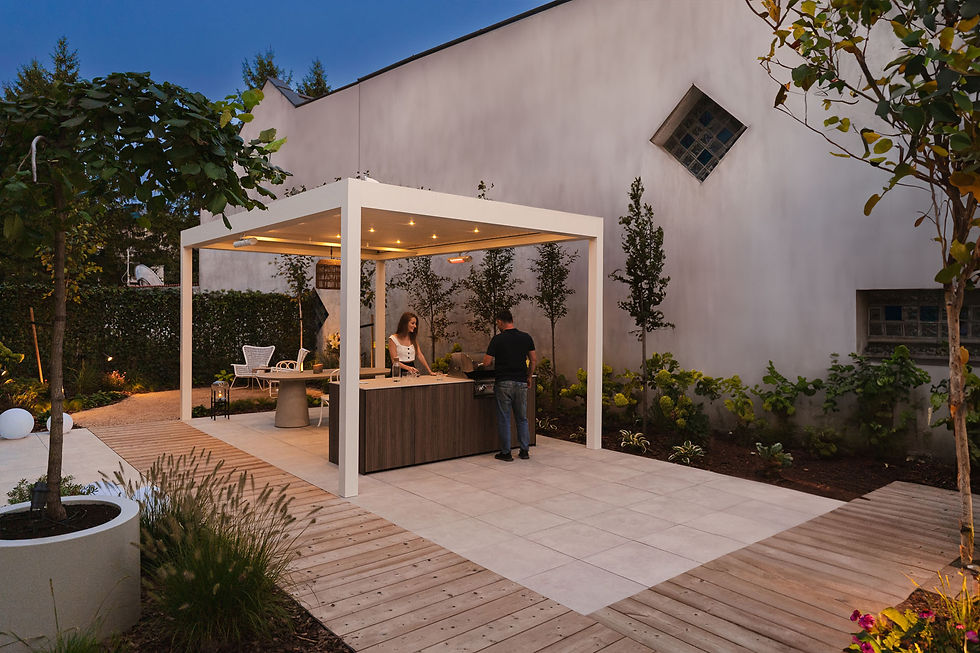
A louvred pergola is an aluminium frame with a roof of motorised slats that rotate to open, part-open or closed. Open, it lets sun through. Angled, it gives shade while letting air move. Closed, it forms a sealed roof that sheds rain into the frame and down the posts. It is the structure that has made the pergola a serious outdoor room in the UK climate.

Every louvred pergola we fit is priced to the terrace, after a survey, because the same 4m x 3m footprint can be specified very differently. The price rises with span, because a wider roof needs deeper beams or an extra post, and with the specification of the louvre system: motor quality, rain sensors that close the roof automatically, integrated lighting and heating.
The Weinor Artares is the louvred pergola we specify most. Its cost depends on the size, the colour, the sensors and whether lighting and heating are built into the frame, and we set all of that out line by line in the quote.
What affects the cost of a pergola glass room?
Add sliding glass sides to a louvred pergola and it becomes a glass room: a sheltered terrace that can be fully open in summer, closed against wind and rain in autumn and, with a heater, used well into the year. The sides are frameless or slim-framed toughened glass panels that slide and stack, and our guide to the pergola with roof and sides explains how the options compare.

Against a louvred pergola of the same footprint, the sides are the main addition to the cost, along with the heating and lighting that make the room usable after dark.
This is the structure we would compare with a glass veranda, which has a fixed glass roof rather than a louvred one. Both take sliding sides; the veranda gives constant shelter, the pergola gives control.
What changes the cost of a pergola?
Size first. Span is the expensive dimension. A roof up to about 4m wide is straightforward; beyond that the structure is engineered and the cost climbs.
Roof type second. Open lattice, fixed polycarbonate or glass, fabric, or motorised louvres. Louvres cost the most and do the most.
Sides third. None, fixed glass screens on the windward side, sliding glass on one or more faces, or fabric screens. Sliding glass is the biggest single addition.
Extras fourth. LED lighting in the frame, infrared heaters, rain and wind sensors, a remote or app control, integrated blinds or screens, and a colour matched to the house glazing.
Fixing and base last. A wall-mounted pergola needs a wall that can take it; a freestanding one needs footings for every post. A level terrace is assumed; building one is a separate cost.
Do pergolas need planning permission?
Most do not. In England a freestanding pergola follows the outbuilding limits, including no more than 2.5m high within 2m of a boundary, and one attached to the house is judged like an extension. Our guide to pergola planning permission goes through the rules.
Is a louvred pergola worth the cost?
If the terrace is used often and the weather is what stops it, yes: a louvred roof deals with midday sun and rain in one structure. It costs far more than a timber pergola and does something a timber pergola cannot. Against a fixed-roof veranda the price is similar and the choice is control versus constancy; against a glass extension it is a fraction of the cost.
Wall-mounted vs freestanding pergola: which costs more?
A wall-mounted pergola fixes to the house on one side and stands on posts on the other, so it needs half the posts and footings of a freestanding one and is usually the cheaper way to cover a terrace beside the house. The saving depends on the wall: solid brick or block takes the load easily, while render, timber framing or a window where the beam must sit add complication. A freestanding pergola can go anywhere in the garden but costs more in posts, footings and a level base.
What does a louvred pergola cost to run?
Very little. The louvre motor uses a small amount of electricity when the roof opens or closes and nothing in between. Lighting in the frame is LED. The largest running cost is the heating, if there is any: an infrared heater draws a couple of kilowatts while it is on, which is the price of a warm terrace in October and is switched off the moment the terrace is empty.
Maintenance is a wash of the frame and louvres once or twice a year, clearing leaves from the gutters in the beams, and keeping the drainage in the posts clear. The motor and the sensors are sealed units. A powder-coated aluminium pergola does not need painting or treating and does not rot, which is the running-cost difference between it and a timber one over ten years.
What should a pergola quote include?
A louvred pergola quote should name the system and model, the footprint and the post positions, the roof specification including motor and sensors, the colour, any sides and screens, the lighting and heating, and the fixing method to the wall or the ground. It should cover survey, manufacture, delivery and installation, and it should say what base is assumed. A terrace that needs levelling or footings that need digging are usually separate items, and they should be on the quote rather than discovered on the day.
Pergola cost questions, answered
How much does an aluminium pergola cost?
Typically £3,500 to £6,000 for a fixed-roof aluminium pergola, £6,000 to £12,000 for a motorised louvred one and £13,000 to £20,000 with sliding glass sides, supplied and fitted including VAT. Within those ranges the span, the roof and the extras set the price, which is why we quote a bespoke pergola after a survey.
How long does a pergola take to install?
A louvred pergola is made to order and installed in a few days once the base is ready. The lead time depends on the system, the colour and the time of year, and we confirm it with the quote.
Louvred pergola or glass veranda?
A pergola if you want to open the roof to the sky. A veranda if you want fixed shelter and a glazed roof. Both take sliding sides.
Talk to our design team
If you would like to talk to us about your project, we will show you both on the terrace in question.