Pergola Roof Options: Which Roof Should Your Pergola Have?
Updated: 12 hours ago

A pergola roof can be one of five things: rotating aluminium louvres that open and close, a fixed glass roof, a retractable fabric roof, a polycarbonate roof, or a solid insulated roof. The louvred roof is the one we install most, because it is the only option that gives sun, shade and full rain cover from the same structure. The right choice depends on how much control you want, how much light the rooms behind the pergola need, and whether the pergola is ever going to become an enclosed room.
What are the pergola roof options?
A traditional open-beam pergola gives shade for a few weeks a year and shelter for none, which is why most pergolas we build now have a real roof. The five options compare like this:
Louvred aluminium roof. Cost: highest. Rain-tight when closed. Light: adjustable from full sun to full shade. Lifespan: decades, with motor servicing.
Fixed glass roof. Cost: high. Rain-tight. Light: maximum, needs shading in summer. Lifespan: decades.
Retractable fabric roof. Cost: mid. Showers only. Light: open or shaded. Lifespan: the fabric typically needs replacing after about ten years.
Polycarbonate roof. Cost: lowest. Rain-tight. Light: diffused, hot in summer. Lifespan: shortest, as sheets yellow and discolour.
Solid roof. Cost: mid to high. Rain-tight. Light: none through the roof. Lifespan: decades.
For a quick shade fix on an open pergola, a shade sail or a loose fabric cover is the low-cost alternative, though neither keeps out real rain.
Louvred pergola roofs
A louvred roof is made of aluminium blades that rotate on a motor. Ours turn through up to 140 degrees, so they can point at the sun, angle away from it, open fully for airflow or close into a rain-tight roof. Some models also slide the closed blades back to open the roof completely. Rainwater runs off the closed blades into a gutter in the frame and down through the posts, so there are no visible downpipes.

The point of a louvred roof is control: the blades open in the morning, angle at midday and close when a rain sensor detects a shower. It is the roof for a pergola that is going to be used every month, including a pergola with roof and sides, and it is the basis of our pergola glass rooms, where sliding glass sides, vertical screens, LED lighting and infrared heating are added to the same frame.
Fixed glass pergola roofs
A fixed glass roof is the choice when the priority is light. Glass keeps the sky visible, lets daylight reach the rooms behind the pergola, and gives permanent rain cover with nothing to operate. It is the roof that most resembles a veranda, and on a wall-mounted pergola it is usually called one.
The compromise is heat and glare. Glass does not open, so on a hot afternoon the space under it needs shading from an under-glass awning or a vertical screen, and solar control glass is worth specifying from the start. The Weinor Terrazza range covers this option in three styles, from the classic Sempra and Originale to the cubic Pure, which spans up to 7 metres without centre posts. Our Weinor Terrazza glass roofs page sets out the range.
Retractable fabric pergola roofs
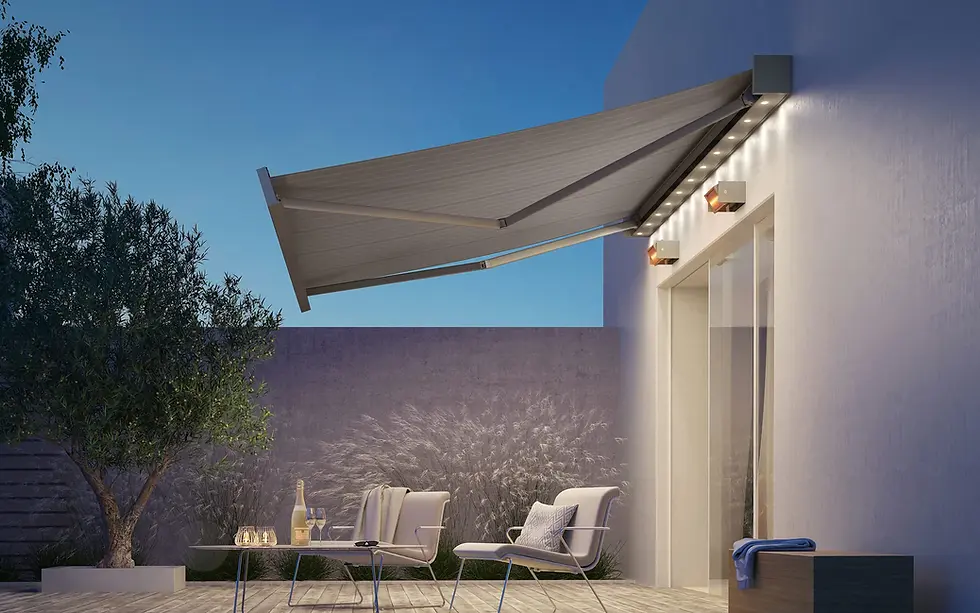
A retractable fabric roof runs on rails inside the pergola frame and folds back in sections when opened. Closed, it gives shade and shelter from light rain; open, the pergola is fully uncovered. It is lighter and quieter than a louvred roof and suits a pergola that is mostly about summer shade.

Fabric is not a rain-tight roof in the way a louvred or glass roof is. Heavy rain pools if the fabric is not tensioned and pitched properly, wind sensors are essential so the fabric retracts in a gust, and the fabric has a life of years rather than decades. Our post on a pergola with a retractable roof covers the fabric option against the louvred one in more detail.
Polycarbonate pergola roofs
Polycarbonate is a fixed translucent sheet, usually multi-wall, fitted into a lightweight frame. It is the simplest and cheapest roof and it does keep the rain off. It is also the roof that ages fastest: it yellows, it collects algae in the flutes, it drums in rain and it can make the space beneath uncomfortably hot because it lets heat in and does not open.
We rarely specify it on a pergola meant to last; glass is the better long-term fixed roof.
Solid pergola roofs
A solid roof is insulated and opaque, in aluminium panels or a timber deck with a membrane. It gives full shelter and shade and turns the pergola into a covered terrace, or, with sides, into something close to a garden room. It also cuts the light to the rooms behind it and removes the sense of being outside.
A solid roof is worth considering where the pergola sits away from the house on a sunny terrace, or where it will house an outdoor kitchen that needs a dry roof and an extractor. Against the house, a louvred roof gives most of the shelter with none of the darkness.
Can you add a roof to an existing pergola?
Often, yes, if the existing frame is sound. On a timber pergola, the simplest additions are polycarbonate sheets or a fabric canopy fixed over the rafters, or a shade sail tensioned between the posts. Check that the posts are set in proper footings and that the rafters can take the extra weight and the wind load, which a roof adds far more of than open beams. A louvred or glass roof is different: it needs its own engineered frame and footings, so it is usually a replacement structure rather than an addition to an old pergola.
Drainage, sensors and structure
Every roof except the open beam needs drainage. Louvred and glass roofs drain into a perimeter gutter and down through the posts. Fabric roofs need a fall so water runs to one edge. The frame that carries the roof needs footings sized for the roof's weight and for snow load, which is why a louvred or glass pergola is engineered rather than assembled.
Sensors are worth the money on any moving roof. A rain sensor closes louvres or retracts fabric; a wind sensor protects fabric and screens; a snow sensor opens louvres so the load does not build. On a louvred roof, motorised control from a wall switch, a remote or an app is standard.
Pergola roof questions, answered
What is the best roof for a pergola?
For year-round use, a louvred aluminium roof. It is the only option that gives sun, shade and rain-tight cover from the same structure, and it can be enclosed with glass sides later.
Can a pergola roof be fully waterproof?
Yes. A closed louvred roof, a fixed glass roof and a solid roof are all rain-tight, with drainage through the frame. Fabric and open-beam roofs are not.
Does a pergola roof need planning permission?
Usually not in England. The roof does not change the planning position; height and position do. Our guide to pergola planning permission sets out the limits.
How much does a pergola roof cost?
The roof is the main cost driver: louvred and glass cost most, fabric and polycarbonate least, and span, sides and heating add to each. Our guide to pergola cost explains what drives the price, and our pergola ideas guide shows what each roof suits.
Talk to our design team
The roof is the decision that decides whether a pergola is a summer structure or an outdoor room. If you are choosing between them, we are glad to talk through your terrace and show the options side by side.