Outdoor Kitchen Worktops: Which Surface Survives a British Winter?
Updated: 15 hours ago
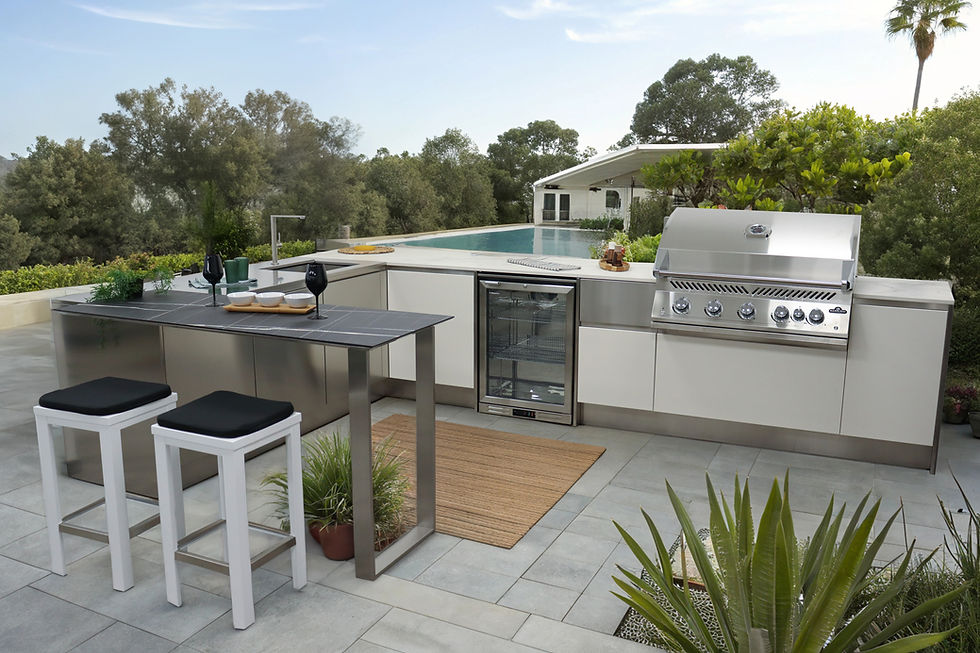
The best outdoor kitchen worktop is one that ignores rain, frost, sun and a hot pan, and the four that do are stainless steel, Gres ceramic, Corian and high-pressure laminate. Steel is the most practical and the most kitchen-like; Gres and Corian look more domestic and are easier to live with under a cover; laminate is the ready-to-go option. Timber, standard indoor laminate and most natural stone do not belong outside. Here is how the four compare and how to choose.
What does an outdoor worktop have to survive?
Four things an indoor worktop never meets. Frost, which finds any water in a porous surface and cracks it. Direct rain, which stains anything that absorbs and streaks anything that does not drain. Ultraviolet light, which fades colour and degrades resins over years of summers. And the outdoor cooking itself: a grill lid dropped on the surface, a cast iron pan straight from the Kamado, charcoal dust, oil and lemon.
Only a short list of surfaces copes with all four without staining, crazing or lifting.
Stainless steel worktops
Steel is the professional kitchen answer and it translates outdoors better than anything else. It does not absorb, so it cannot stain or freeze-crack; it takes a hot pan without marking; and it is the same material as the 304 stainless steel units beneath, so the kitchen reads as one piece. Brushed steel shows fingerprints and light scratches and, like a chef's kitchen, develops a soft patina rather than staying showroom-new. Some clients love that; some prefer a surface that stays as it was.
Choose steel for a kitchen that will be cooked on hard and often, for a modern terrace where the kitchen should look architectural, and for any kitchen without a roof.
Gres ceramic worktops
Gres is a dense, fired porcelain ceramic, non-porous and extremely hard; if you have been searching for porcelain or sintered stone worktops (brands such as Dekton and Neolith), this is the same family of material. It does not stain, does not fade, shrugs off frost and takes heat, and it is available in finishes from a pale stone look to a deep matt charcoal, so it gives the outdoor kitchen the appearance of an indoor one. It is thinner and lighter than natural stone and, unlike marble or limestone, it does not etch with lemon or wine.
Its one weakness is a hard knock to an edge, which can chip, so an outdoor kitchen in Gres is best under a pergola or veranda and away from the worst of the barbecue traffic. Choose Gres for a covered kitchen that should look like part of the house.
Corian worktops
Corian is a solid surface made from mineral filler and acrylic resin. It is joint-free, warm to the touch, easy to shape into curves and integrated sinks, and it repairs: a scratch or a burn mark can be sanded out. It is not as heat-tolerant as steel or Gres, so a trivet is needed for a pan straight from the grill, and its colours are best kept lighter and under cover, where the sun will not work on the resin over the years.
Choose Corian for a kitchen with a sink and a long serving run, for softer colours, and for a covered terrace where the surface will be treated like an indoor worktop.
High-pressure laminate worktops
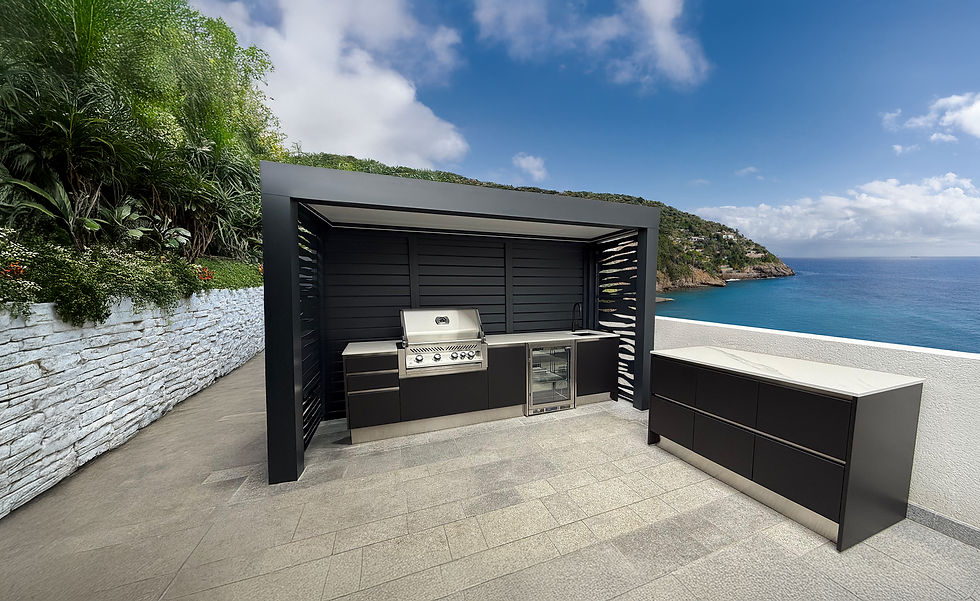
High-pressure laminate is the surface on our ready-to-go range: an all-black kitchen with an HPL top, available for immediate delivery. HPL is a resin-bonded laminate designed for exterior use, resistant to water, frost and ultraviolet light, and it looks sharp in black on a modern terrace. It takes normal cooking use well but, like Corian, prefers a trivet under a very hot pan.
Choose laminate when the kitchen needs to be installed this month, and for a contemporary, all-black scheme.
What about stone, timber and concrete?
Granite is the most searched natural stone for outdoor kitchens, and a dense, sealed granite in a darker colour is a fair choice: hard, heat-tolerant and frost-resistant. It is heavy, needs resealing periodically, and pale granites can mark. Marble and limestone stain and etch and should be left indoors. Timber swells, splits and greys. Concrete absorbs oil and can crack in frost unless it is sealed obsessively.
Which worktop for which kitchen?
How the four compare:
Stainless steel: takes a hot pan, frost-proof, never fades; shows scratches as a patina. Best uncovered or for hard cooking.
Gres ceramic: takes a hot pan, frost-proof, never fades or stains; edges can chip. Best under cover where it should look like an indoor kitchen.
Corian: needs a trivet, best kept under cover and in lighter colours; repairable and joint-free. Best for a long serving run with a sink.
High-pressure laminate: needs a trivet, exterior-grade and UV-resistant; the quickest to install. Best for an all-black modern scheme.
For an uncovered kitchen choose steel; under a louvred pergola or glass veranda, Gres or Corian can be chosen for looks. Our outdoor kitchen ideas show how each looks in a finished kitchen.
Whatever the surface, plan the cover and the kitchen together, because the roof decides how hard the worktop has to work; our post on covered outdoor kitchen ideas sets the options out. And whichever you choose, it sits on the same modular stainless steel units, which our post on the modular outdoor kitchen explains.
Caring for an outdoor worktop
All four surfaces want the same simple routine: wipe after cooking, rinse off charcoal dust and citrus rather than leaving them, and cover the kitchen or its worktop through the deepest winter if it is not under a roof. Steel takes a stainless cleaner along the grain; Gres and Corian take warm water and a mild detergent; laminate the same. None of them needs sealing.
Outdoor kitchen worktop questions, answered
Can you put a hot pan on an outdoor worktop?
On steel and Gres, yes. On Corian and laminate, use a trivet for a pan straight from the grill.
Do outdoor worktops need sealing?
Not the four we fit. Steel, Gres, Corian and exterior-grade laminate are all non-porous. Natural stone and concrete do need sealing, which is one reason we do not recommend them.
Will an outdoor worktop fade?
Gres and steel do not. Corian and laminate are best in lighter colours or under cover, where ultraviolet exposure is limited.
Talk to our design team
The worktops on our outdoor kitchens come in steel, laminate, Gres and Corian, and choosing between them is part of the free design service. Tell us how you cook and we will recommend one.