Electric Awning: How Motorised Patio Awnings Work and What to Specify
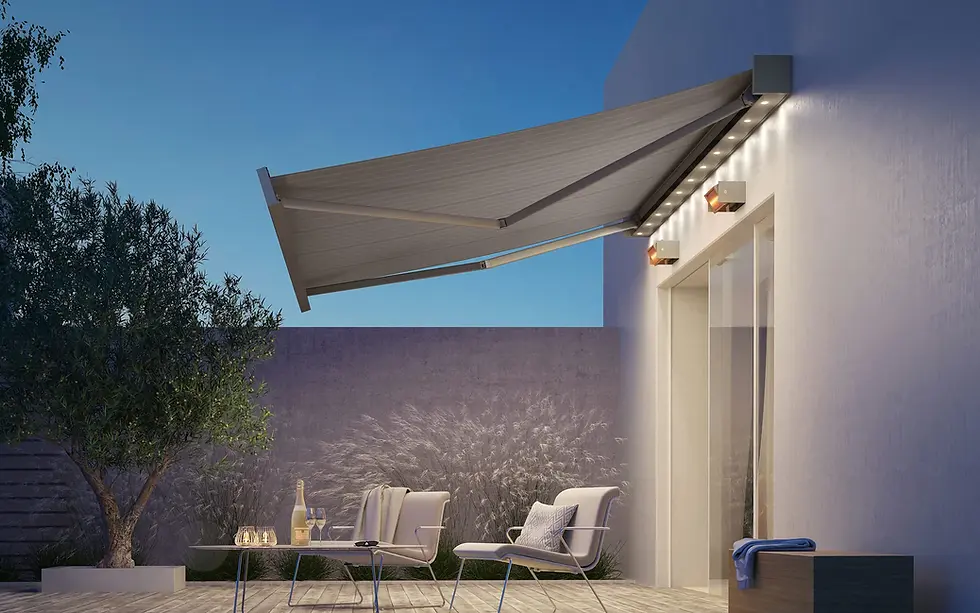
An electric awning is a retractable patio awning driven by a motor instead of a hand crank, controlled from a wall switch, a remote or a phone, and usually paired with sensors that extend it in sun and pull it in when the wind rises or rain starts. The motor is the part that makes an awning get used. A manual awning is left in because winding it out is a chore; an electric one is out whenever the patio would be better for it, and back in before the weather can damage it.
How does an electric awning work?
A tubular motor sits inside the roller that the fabric winds onto. Press the switch and the roller turns, the folding arms extend under spring tension and the fabric unrolls to its full projection. Reverse and the arms fold back while the fabric rolls up. Limits are set at installation so the awning stops in exactly the right place each time.
Control can be a wall switch, a handheld remote, or an app that also runs the lighting, heating and any other outdoor systems. On the Weinor awnings we install, motorised operation is standard, with manual override available depending on the setup.
What do the sensors do?
They make the awning look after itself. A sun sensor extends the awning when the light reaches a set intensity, so a south or west-facing patio is shaded before it heats up rather than after. A wind sensor retracts it when gusts reach a set speed, which is the single most important protection for the fabric and arms. A rain sensor retracts it before water pools on the fabric. The BiSens weather sensors fitted to our Weinor awnings do all three, and a dedicated product protection sensor goes further, pulling the awning in when it detects vibration from gusts even before the wind speed threshold is reached.
If you are only going to specify one sensor, make it wind. An awning left out in a squall is the commonest way to write one off.
Which cassette type?
Three, and the choice is about how the awning looks when it is closed.

A full-cassette awning retracts the fabric and the arms into an enclosed aluminium housing, so nothing is exposed to the weather and the closed awning reads as a slim bar on the wall. It is the choice for a house where the closed awning will be looked at all winter.
A semi-cassette protects the rolled fabric in a housing while the folded arms sit beneath it. It is a little slimmer and a little less expensive.
An open awning has no housing; the roller and arms are exposed. It suits a position under a soffit or a balcony where the structure above gives the protection a cassette would.
How big can a motorised awning be?
Made to measure. The Weinor range we install is manufactured to the millimetre and available up to 5.5 metres wide in the standard models, with the N2000 covering greater widths where maximum shade matters. Projection, the distance the awning reaches out from the wall, varies by model and is typically somewhere between about 1.5 and 4 metres; deep enough to shade the table, not so deep that it fights the wind. Two awnings side by side, run from one control, cover a very wide elevation without a single oversized unit.
Which fabric?
A solution-dyed acrylic, in one of more than 150 fabrics on the range we fit. Acrylic holds its colour under UV, sheds water and dries quickly. Darker fabrics shade more; lighter ones let the patio stay bright. Pattern is a matter of taste, but a fabric that matches or quietly contrasts with the render or brick behind it ages better than a bold one. The frame is powder-coated in a RAL colour, and matching it to the window and door frames is the detail that makes the awning look built in.
What extras are worth having?
LED lighting in the front bar or the arms, so the patio is usable after dark. Infrared heating for cooler evenings, mounted on the wall beneath the awning rather than on the moving parts. Side screens for wind and privacy at seating height. A vertical awning on the open front of a patio roof, cutting glare and low sun without blocking the view. Each of these runs from the same controls and sensors as the awning itself.

Does an electric awning need planning permission?
Normally not on a house in England: a retractable awning fixed to the rear wall is a minor addition and sits within permitted development. Listed buildings need consent for anything fixed to the fabric of the building, and homes in conservation areas or under an Article 4 direction should check first. The Planning Portal covers the general position. Flats and leasehold properties usually need the freeholder's agreement regardless of planning.
What does an electric awning cost?
More than a manual awning of the same size, with the cassette type, width, projection and sensors as the variables, which is why we quote against the elevation rather than from a list. Don't economise on the motor or the wind sensor: the first makes the awning get used, the second keeps it alive. Our Weinor awnings covers the models and how they differ, and our awnings and canopies range covers the fixed and fabric alternatives.
Electric awning questions, answered
What happens to an electric awning in a power cut?
Motorised awnings can be supplied with a manual override so the awning can be wound in by hand. Ask for it if the awning will be left extended when the house is empty.
Can an electric awning be left out in the rain?
Light rain, yes, provided the awning has enough pitch for water to run off. Heavy rain pools on the fabric and strains the arms, which is what the rain sensor prevents.
How long does the fabric last?
A quality solution-dyed acrylic typically keeps its colour and strength for around eight to twelve years, depending on aspect and how often it is out. The frame, motor and arms outlast the fabric, and the fabric can be replaced on the same frame when the time comes.
Can a manual awning be motorised?
Often, yes: many manual awnings can take a retrofit tubular motor in the roller, but it depends on the model, the roller size and the condition of the arms. On an older or worn awning, replacing it with a motorised unit is usually the better buy.
Can it be added to an existing patio roof?
Yes. Under-glass and over-glass conservatory awnings shade a glass roof, and a vertical awning closes the open front of a veranda or pergola. Both are motorised and sensor-controlled in the same way.
Talk to our design team
If you want shade that arrives before you think to ask for it, our Weinor awnings are motorised and sensor-controlled as standard, and we are happy to measure up and advise before you choose a model.


