Front Door Colours: Choosing Black, Grey or a Colour
Updated: 10 hours ago

The most popular front door colours in the UK are black, anthracite grey (RAL 7016), deep green and navy blue. Black suits most period houses, anthracite most modern ones, and green or navy give a statement door its own presence. Choose by testing a large sample against your own brick or render, and relate the door to the window colour.
On a statement door with a factory-applied finish the choice is permanent in the good sense: the colour holds up to the weather and is not repainted every few years. So it pays to get it right.
Black front doors
A black front door (RAL 9005, jet black) is the classic statement and one of the most popular choices. Black reads as formal and expensive on almost any facade. On red brick it is the traditional Georgian and Victorian pairing. On white render it draws the entrance like a frame. On a contemporary house in grey brick or timber it disappears into the elevation and lets the door's proportions do the talking.
The one caution is a very dark facade, dark brick or dark render, where a black door can vanish. There, a slightly lighter dark grey, or a colour, gives the entrance back its presence. Black also shows dust more than grey in strong sun; a matt or textured finish reduces that.
Grey front doors
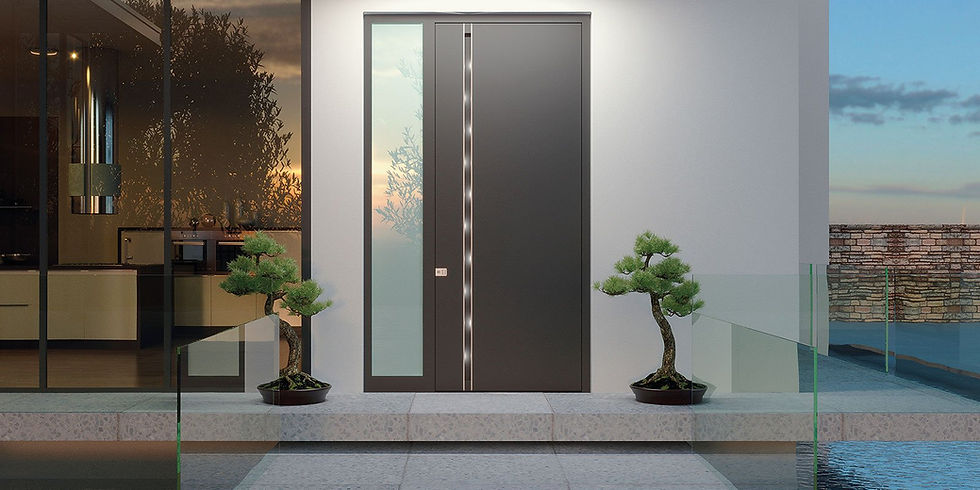
A grey front door is the modern default and for a reason: anthracite grey (RAL 7016) reads as near-black at a distance, softer close to, and it is the same colour most people choose for their windows, so door and glazing match without thinking about it. Lighter greys, such as slate grey (RAL 7015) or basalt grey (RAL 7012), suit stone houses and pale render, where black would be too hard. Warm greys with a hint of brown, such as quartz grey (RAL 7039), sit well against buff brick.
Grey is the safe choice, which is both its strength and its weakness. If the windows are grey, a grey door is coherent but quiet. A statement door often earns a colour.
Colour: greens, blues and reds
Statement doors are made to order in a wide range of colours, so the palette is not limited to a paint chart. The RAL references below are the closest standard shades; always check a physical sample. The rule of thumb is one strong colour on the door and nothing else on the facade competing with it.
Green front doors
Deep greens, from racing green to a blue-black green, are the traditional door colour on period houses and look right on brick, stone and painted render. Fir green (RAL 6009) and moss green (RAL 6005) are the closest standard shades.
Blue front doors
Navy and ink blue give the same depth with a cooler cast and suit white or pale houses. Look at sapphire blue (RAL 5003) or the near-black black blue (RAL 5004); steel blue (RAL 5011) is darker and greyer.
Red front doors
Deep red and burgundy are Georgian and Victorian favourites, strong against yellow London stock brick and pale stone. Wine red (RAL 3005) is the classic deep red.
Pastels
Muted pastels, sage, duck egg and pale blue, suit cottages and coastal houses and rarely suit a contemporary statement door.
Which colour suits which house?
Red brick: black, deep green or navy; avoid red on red.
Yellow London stock brick: black, deep red or dark green.
White or pale render: navy, black, deep green or a strong red.
Stone: slate or mid greys, sage or deep green; black can be hard against pale stone.
Dark brick or dark render: a mid grey or a colour, so the door does not vanish.
Georgian and Victorian houses: black, deep green, navy or deep red, the traditional period palette, which suits Victorian front doors in particular.
Contemporary houses: black or anthracite, matched to the window frames.
Matching the door to the windows
The door should relate to the windows, not necessarily match them. Two approaches work. The first is a single colour across the house: black or anthracite windows and patio doors with a front door in the same colour, which gives a drawn, consistent elevation. Our black aluminium windows post covers that route. The second is dark grey or black windows with a coloured door, so the entrance is the one accent. Both work; what does not work is a third colour. A front door canopy is the other element to colour-match, because it frames the door from above.
Our statement front doors can be colour-matched to the windows, and a deliberate contrast is chosen from the same colour chart.
Finish: gloss, matt or textured
Gloss reflects light and shows every fingerprint and speck; it suits a traditional panelled door in a deep colour. Matt absorbs light, reads softer and hides marks; it is the usual choice on a flush contemporary door. Textured finishes, a fine grain in the surface, add depth to dark colours and resist scuffs. Special and textured finishes are quoted case by case. Dual colour is available too: a black or coloured outside face with a white or off-white inside face that suits the hall, which is usually right on a period house.
Testing colour before committing
A colour chart tells you almost nothing. Hold a large sample against the wall the door will sit in, at the time of day you most often see it, in the shade the porch casts. Look at it from the street and from the path. Dark colours lighten in sun and darken in shade more than pale ones. We keep samples of the most specified colours and bring them to the house, because the same anthracite looks blue against one brick and brown against another.
Front door colours questions, answered
Will a dark front door fade?
Not on a door with a factory-applied exterior finish. The finish is designed for outdoor use and holds its colour for many years without repainting.
Can I change the colour later?
A factory finish can be re-coated, but it is a specialist job rather than a weekend with a brush. Choose carefully with samples on the wall.
Talk to our design team
The right colour is the one that looks right on your wall, in your light. Our statement front doors page covers the rest of the specification, and we are glad to bring the samples round.