Orangery Kitchen Extension: Stylish and Practical Ideas
Updated: 8 hours ago

An orangery kitchen extension puts the kitchen in the brightest room of the house. The lantern lights the island from above, the full-height glazing puts the garden at the end of the worktop, and the solid roof perimeter and piers give the room the warmth and the wall space a kitchen needs. It is the most popular use for an orangery and, done well, the one that changes daily life most. This is how to plan it, what the layouts look like and what it costs.
Why choose an orangery kitchen extension?
A kitchen is the busiest room in most homes and the one that suffers most from poor light. An orangery answers that directly. Where a brick extension lights a kitchen from its windows, an orangery lights it from the roof, so the middle of the room, where the island and the table go, is the brightest part rather than the darkest. The piers give you tall cupboards and wall units; the plastered ceiling perimeter takes the extractor duct, the downlights and the speakers; the glazing between the piers gives the room its view. Unlike a conservatory, an orangery is warm enough to cook and eat in through January, which is the whole point of a kitchen.
Orangery kitchen layouts that work
The layout depends on where the existing kitchen is and whether it moves.
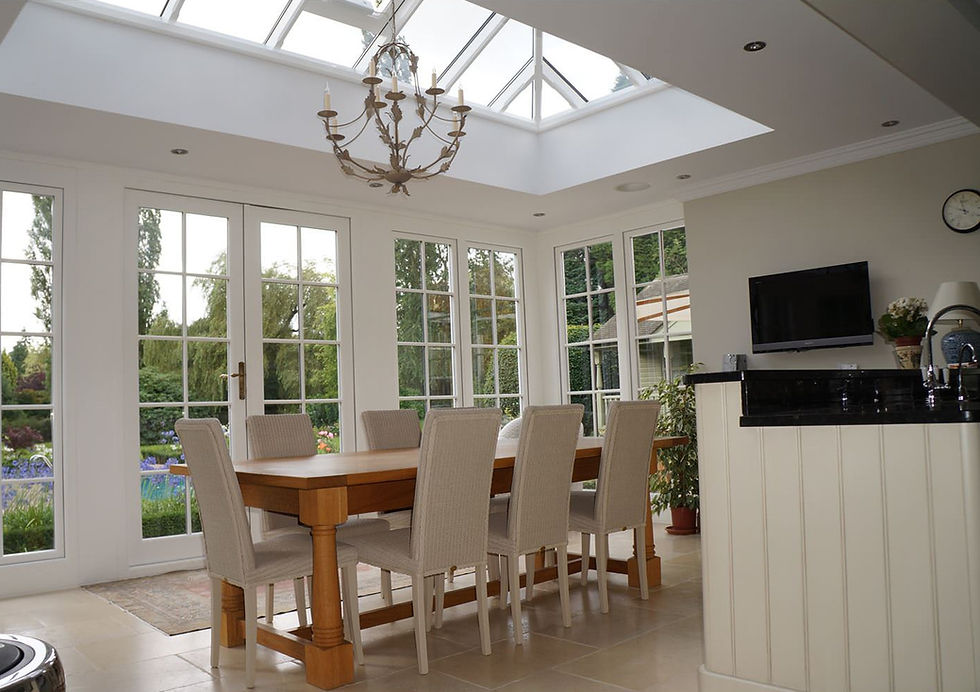
Kitchen stays, dining moves. The simplest and often the best. The original kitchen keeps the cooking; the orangery takes the table, under the lantern, with the doors beyond it. The two rooms are knocked through and the floor runs between them.
Kitchen moves into the orangery. A single run of units along the house wall, an island facing the garden, and the lantern centred over the island. The piers on the garden side stay free of units so the glazing is uninterrupted. This works from about 4m x 4m upwards.
L-shaped kitchen with a dining end. Units along the house wall and one return wall, leaving the garden elevation and the far end for the table. Suits wide, shallow orangeries running the width of the house.
Galley into a garden room. Units on both long walls of a narrow orangery, with the lantern running the length of the roof and the doors at the end. Suits side returns.
In every layout the sink or the hob should face the garden if it can, because that is where you stand longest.
Most orangery kitchens are kitchen-diners. Put the table on the garden side of the island, under or just beyond the lantern, so it gets the light and the view, and give it a pendant of its own for the evening. If the orangery is wide enough, a pair of armchairs at the far end turns it into a living kitchen.
Small orangery kitchen extension ideas
A small orangery, around 3m x 3m or 3m x 4m, is usually better as a dining orangery attached to the existing kitchen than as a kitchen in itself. Push the table into the orangery under the lantern, use the piers for a tall larder or a dresser, and keep the cooking where the services already are. If the kitchen must move, one run of units along the house wall and a small island, or a peninsula off the return, is as much as the space will take without losing the glazing. Our small orangery ideas cover the proportions in detail.
Designing the structure around the kitchen
A kitchen changes what the orangery structure has to do. The roof deck needs to carry an extractor duct to an outlet, usually through the fascia, and the lantern should sit over the island rather than over the geometric centre of the room if the two differ. Piers on the house side can be built wider to take a full-height cupboard or to hide a boiler flue. Sockets, lighting circuits and the underfloor heating manifold all go in the piers and the perimeter ceiling, so the kitchen plan has to be settled before the structure is drawn. A hardwood orangery is made to the opening, which is why we ask for the kitchen layout at the first design meeting rather than the last.
Glazing, heating and ventilation
Kitchens make heat and steam, so the orangery's environmental design matters more here than in a dining room. Solar control glass in the lantern and on any south- or west-facing elevation keeps the sun off the worktop in summer. Opening vents in the lantern, motorised and linked to a rain sensor, pull cooking heat out at the highest point. A proper ducted extractor, not a recirculating one, deals with steam. Underfloor heating under a stone or porcelain floor keeps the room warm without radiators taking up pier space. Low-emissivity glazing throughout keeps the heat in.
Integrating the kitchen design
The kitchen style should follow the orangery's frame. Painted hardwood frames in a traditional profile suit shaker and classic kitchens in the same paint range; slimmer, plainer frames in a dark colour suit handleless modern kitchens. Take one colour from the frames and repeat it on the island or the tall units, and take the floor through from the house without a threshold. Pendant lights over the island should hang below the lantern well, not inside it, so the lantern stays clear by day.
Blending indoor and outdoor living
The doors make the kitchen. Wide sliding doors or a bifold across the garden elevation, with a level threshold and a terrace in the same stone as the floor, let the kitchen open to the garden in summer, and an outdoor kitchen on the terrace is the natural next step. A kitchen is only one of the other orangery uses worth considering.
Orangery kitchen extension cost
An orangery kitchen extension costs the orangery plus the kitchen. The structure is priced by size and specification; fit-out extras such as underfloor heating, a stone or timber floor, cabinetry, lighting design and plastering come on top, and the kitchen itself is priced separately. Our orangery cost guide sets out typical prices.
Orangery kitchen questions, answered
Can you put a kitchen in an orangery?
Yes, and it is the most common use. The solid roof perimeter and the piers give the wall space, the ducting routes and the warmth a kitchen needs; the lantern gives the light.
Does an orangery kitchen get too hot?
Not if the glazing is specified for it. Solar control glass in the lantern, opening roof vents and a ducted extractor keep a south-facing orangery kitchen comfortable in summer.
Does an orangery kitchen extension need planning permission?
Usually not in England, if it stays within permitted development limits (3m deep, 4m on a detached house, no higher than 4m). Building regulations apply. Our guide to planning permission for an orangery has the detail.
Talk to our design team
A kitchen in an orangery is a kitchen with the garden at the end of it and the sky above it. If that is the room you want, our orangery range shows what the structure can do, and we are glad to plan the kitchen and the orangery together from the start.


